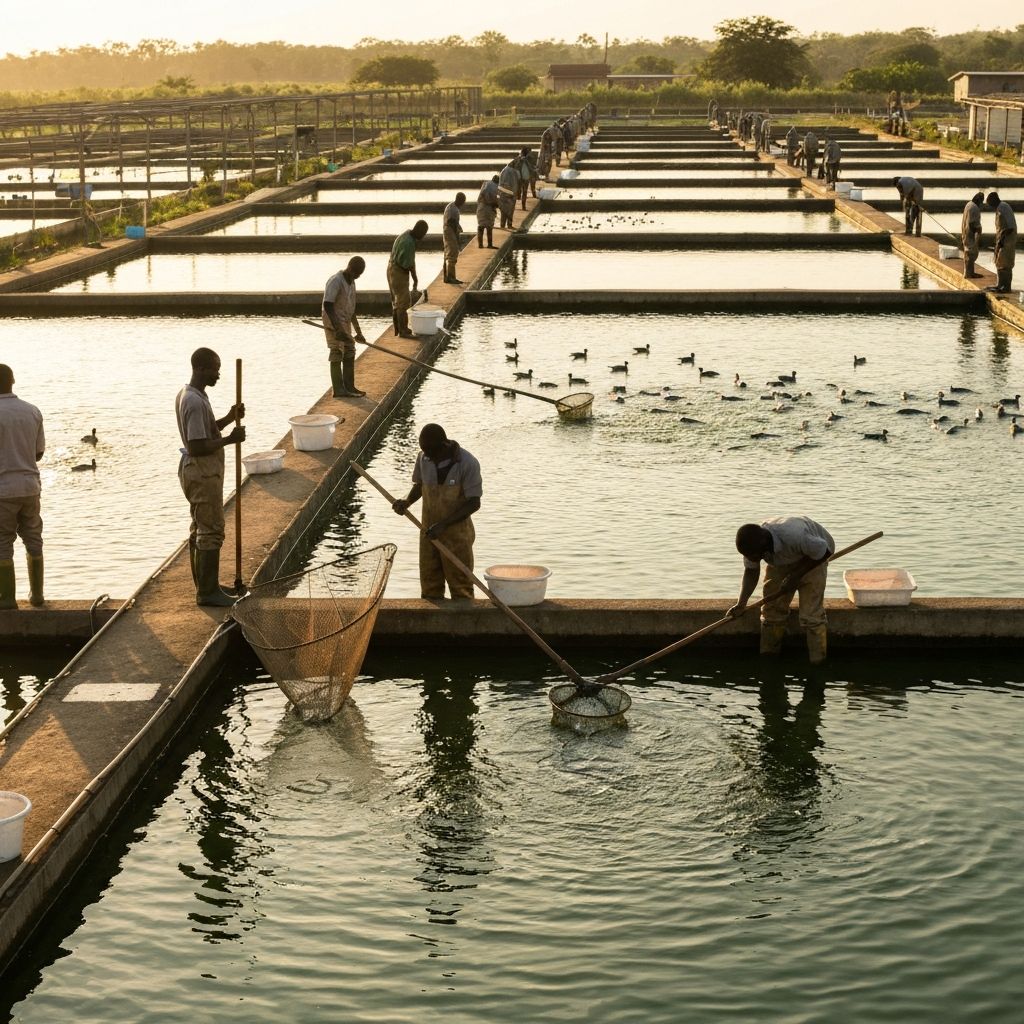
Sustainable Fish Farming Practices for African Communities
There is a version of the sustainability conversation in aquaculture that treats it as a premium, something that large, well-resourced operations do to earn certifications and access export markets. That version is not the one that matters most to a fishing community on the shores of Lake Chad, or a farmer drawing from an already-stressed river system in Nigeria's Middle Belt.
For those communities, sustainability is not a branding exercise. It is a survival strategy.
Understanding What "Sustainable" Actually Means
Sustainable aquaculture, at its most fundamental, means producing fish in a way that does not compromise the capacity to produce fish in the future. That definition encompasses water quality, ecosystem health, genetic stock integrity, and the socioeconomic stability of farming communities. It is expansive in scope precisely because the consequences of getting it wrong play out across generations.
In the African context, this means paying particular attention to a few specific risks:
Overstocking: The single most common mistake in smallholder aquaculture across Africa. When pond density exceeds carrying capacity, dissolved oxygen levels drop, stress responses increase, disease vulnerability rises, and feed conversion ratios deteriorate. The result is poor growth, high mortality, and the kind of crop failure that drives farmers to abandon the sector entirely. Proper stocking density management is not complicated, but it requires knowledge that most smallholders currently lack.
Water source dependence: Many small-scale farms draw from shared water sources, rivers, streams, community boreholes, without adequate consideration of how their operations affect downstream users, or how upstream users affect them. Water governance frameworks in most African countries are still catching up with the growth of aquaculture, which means individual farmer responsibility matters more, not less.
Feed sourcing: Fishmeal-based feeds, derived from wild-captured fish, create a perverse dependency in an industry whose purpose is to reduce pressure on wild fish stocks. Transitioning to alternative protein sources, insect meal, duckweed, single-cell proteins, is one of the most important technical frontiers in sustainable African aquaculture, and one where youth innovation is already producing promising results.
Waste management: Uneaten feed and fish waste create organic loading in receiving water bodies that can trigger algal blooms and hypoxic zones. Closed or semi-closed systems that treat effluent before discharge are not universally achievable at small scale, but even simple settling ponds and strategic discharge timing can significantly reduce impact.
Practical Sustainable Practices We Teach
At AquaProX Africa, our capacity building programs build sustainability into the technical foundation rather than treating it as an afterthought. Here are the core practices we emphasise:
1. Accurate Biomass Estimation and Feeding Management
We teach farmers to weigh sample fish regularly, calculate total biomass, and adjust feed inputs accordingly. Overfeeding is both the most wasteful and the most environmentally damaging practice in pond aquaculture. Getting feeding right is simultaneously the most impactful economic improvement a farmer can make and the most meaningful environmental one.
2. Regular Water Quality Monitoring
We equip trainees with basic water quality testing tools and the knowledge to interpret results. Dissolved oxygen, pH, ammonia, and turbidity are the four parameters that predict pond health most reliably. A farmer who monitors these consistently and adjusts management in response is operating sustainably even if they cannot articulate why.
3. Integrated Pond Management
For farmers who grow staple crops, we teach integrated approaches, using pond water for irrigation, incorporating pond sludge (nutrient-rich effluent) as fertiliser, and in some cases introducing vegetable production around pond edges that provides natural shading and reduces algae problems. This integration dramatically reduces external input requirements and creates multiple income streams from a single piece of land.
4. Native Species Prioritisation
Where possible, we encourage farmers to work with indigenous fish species, African catfish (Clarias gariepinus), Nile tilapia where it is native, and various carp species, rather than pursuing exotic introductions. Native species are better adapted to local conditions, less susceptible to endemic pathogens, and present no biosecurity risk if there is escape to natural water bodies.
5. Record Keeping and Data-Driven Decision Making
This is perhaps the most overlooked sustainability practice: systematic record keeping. Farmers who record stocking dates, feed purchases, mortality events, water test results, and harvest weights can identify problems early, understand trends over time, and make evidence-based decisions about when to alter their practices. We introduce simple paper-based record systems and, increasingly, mobile phone applications that make data entry easy and analysis automatic.
The Community Dimension
Sustainable fish farming cannot be achieved at the individual farm level alone. Water quality upstream affects everyone downstream. Disease outbreaks in one farm can spread to neighbouring ponds. The market price a farmer receives depends in part on the collective reputation of the region's fish.
This is why our community engagement programs work to build collective management structures, farmers' associations, community water-use agreements, shared disease response protocols. Individual excellence matters, but it is most durable when it is embedded in community systems that reinforce and protect it.
The communities that will thrive in African aquaculture over the next generation are those that take the long view, investing in the health of their water resources, the knowledge of their young farmers, and the institutions that help them navigate challenges together.
Sustainability, in the end, is simply the decision to farm as if the future matters.
Salifu Eyiojotule Daniel is the Founder and CEO of AquaProX Africa. He writes on youth empowerment, sustainable aquaculture, and the development of Africa's blue economy.