Farming Fish in a Shipping Container: The RAS Revolution Coming to Africa
Imagine growing a metric ton of fish per month inside a shipping container in the middle of Lagos.
No pond. No river. No dependence on rainfall, seasonal temperature swings, or the availability of land. The water recirculates through filters and back into the tanks. The fish grow faster than they would in any pond. The yield per square meter makes conventional earth pond farming look, by comparison, like subsistence gardening.
This technology is not a concept. It is not a pilot project in a European research station. It is operational, commercially proven in multiple countries, and it is arriving in Africa right now, faster than most people in the sector realise.
It is called Recirculating Aquaculture Systems, or RAS. And it is going to change the fundamental geography of where fish can be grown, who can grow them, and how much they can produce.
What RAS Actually Is
Strip away the jargon and RAS is a straightforward idea: grow fish in tanks where the water is continuously cleaned and reused, rather than flowing away and being replaced.
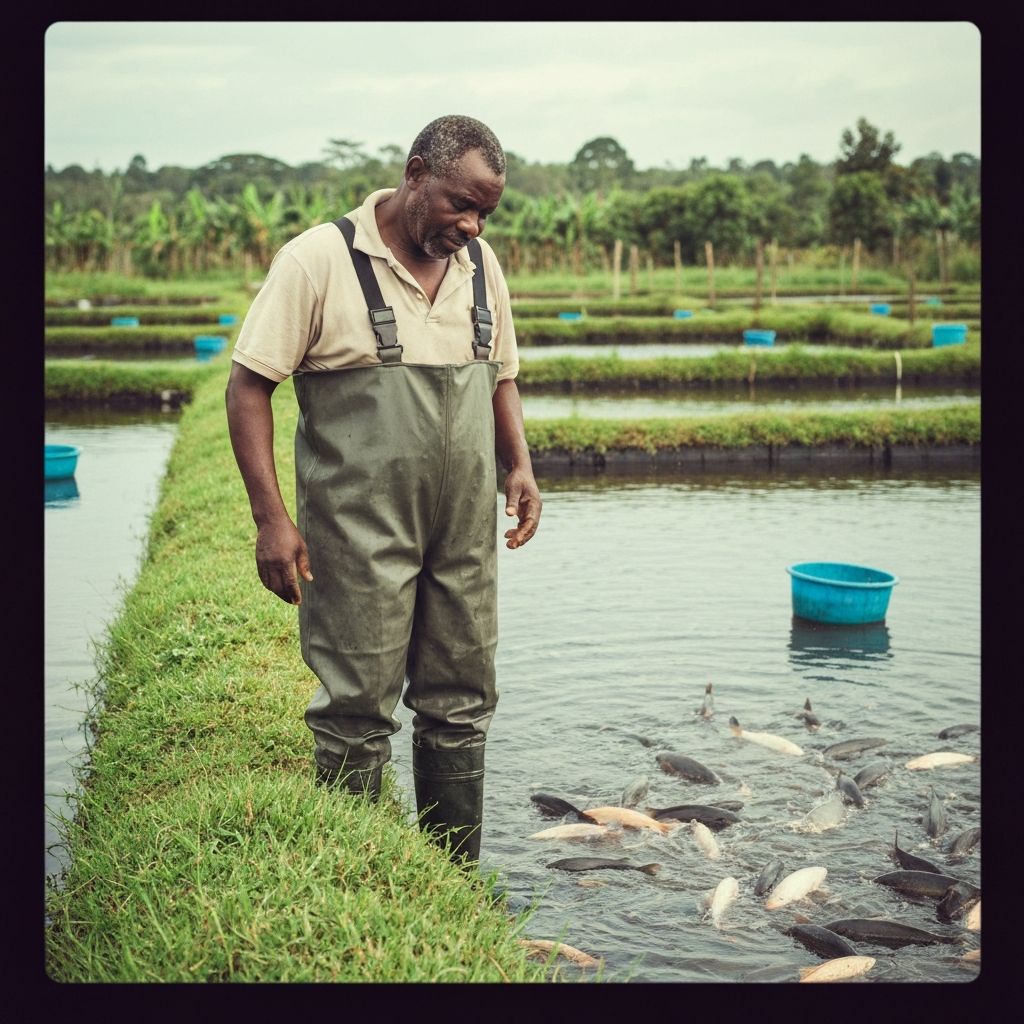
In a conventional open pond or flow-through system, water quality is managed by dilution. Bad water out, fresh water in. This works if you have abundant clean water and the space to accommodate it. Most urban and peri-urban producers do not. And even rural producers who have the water face the fundamental constraint that their fish share that water with whatever runoff, pollution, and pathogen load enters from the surrounding environment.
RAS eliminates that dependency entirely.
Here is how the water cycle works in a fully recirculating system:
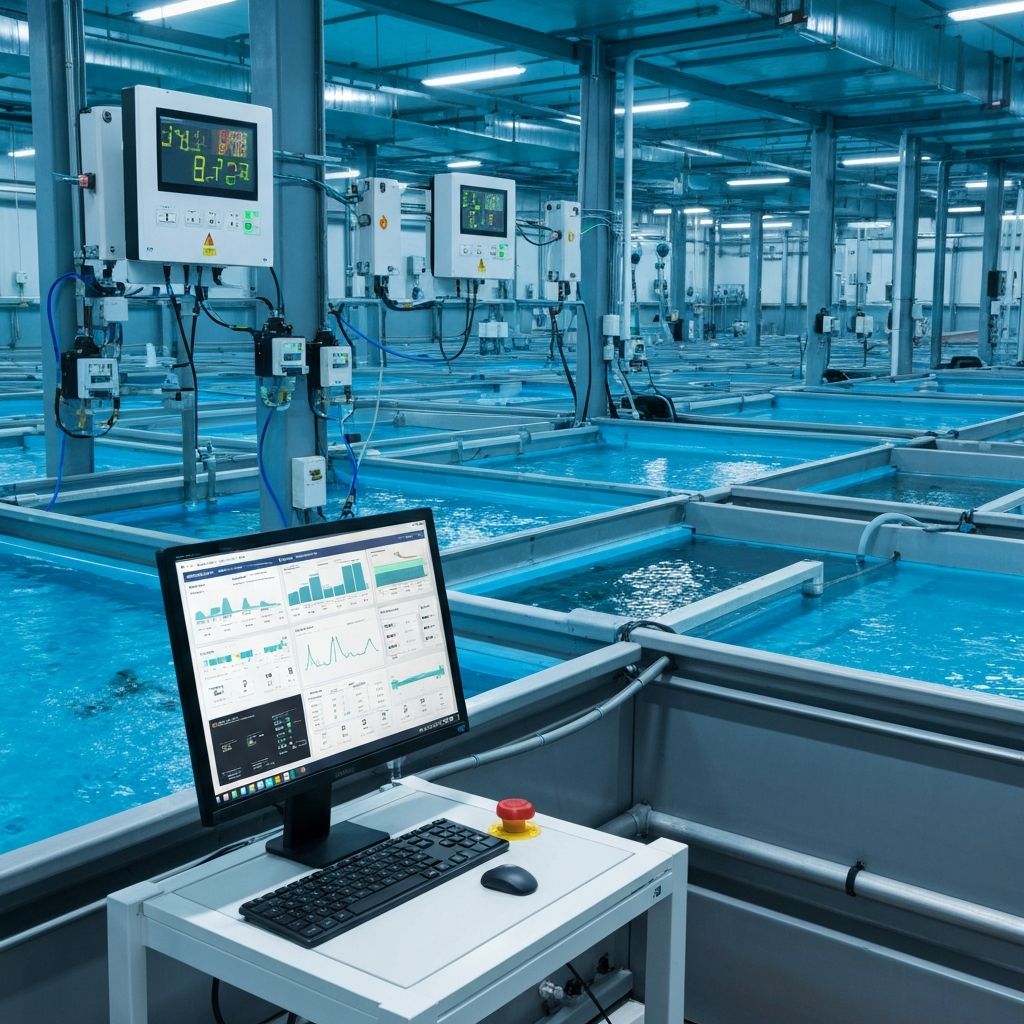
Fish live in circular tanks, fiberglass or concrete, where careful tank design keeps water in constant motion. This motion carries fish waste and uneaten feed toward a central drain at the bottom of the tank. That solid waste flows first into a mechanical filter, essentially a fine mesh that physically removes particles from the water. The clarified water then passes through a biological filter, a chamber packed with plastic biofilm media colonised by beneficial bacteria that convert the dissolved ammonia produced by fish respiration into nitrite, and then into the much less toxic nitrate. From there, the water passes through an ultraviolet sterilisation unit that kills pathogens, and sometimes through a degassing column that removes excess carbon dioxide. Finally, fresh oxygen is injected before the water returns to the fish tanks.
The result: water that is continuously cycling through this treatment loop, losing typically only 5 to 10 percent of its volume per day to evaporation and splash, which is topped up with fresh water. A conventional pond that holds 1,000 cubic meters of water might require that entire volume to be replaced multiple times per growing cycle. An equivalent RAS installation uses a fraction of that water across the entire production year.
The Numbers That Stop the Conversation
When people first encounter RAS, the reaction is often skeptical. Tanks inside buildings? Sophisticated filtration? This sounds expensive and complicated. Why not just use ponds?
The answer requires looking at the right numbers.
Stocking density. In a well-managed earth pond, African catfish are typically stocked at 5 to 15 fish per cubic meter of water. In a mature RAS installation with excellent water quality management, the same species can be stocked at 80 to 150 fish per cubic meter. The per-square-meter yield difference is not incremental, it is transformative.
Water use. A 10-ton-per-year RAS facility producing catfish uses roughly 500 to 1,500 cubic meters of water annually. A conventional pond system producing equivalent output would use 10 to 30 times that volume. In regions where water access is already stressed or must be purchased, this differential is existential.
Biosecurity. Closed systems are isolated from the pathogen pressures of open water environments. Disease introduction events, which can devastate open pond production, are dramatically rarer in RAS. When they do occur, the closed system means they are far easier to contain and treat without cross-contamination of other ponds or natural waterways.
Year-round production. Earth ponds in Africa are influenced by seasons. Water temperature drops in harmattan. Oxygen dynamics change with algae bloom cycles. Feed intake and growth rates fluctuate accordingly. In a RAS facility, temperature is maintained at the optimal range for the species being grown, twenty-four hours a day, 365 days a year. Growth rates accelerate and predictability, for farmers, and for the buyers they supply, increases enormously.
Location independence. A RAS facility can be built anywhere with electricity and a modest water source. This means urban markets can be supplied by producers located within those markets, eliminating cold chain losses and transport costs. It means arid and semi-arid regions that cannot support conventional aquaculture can produce fish. It means a rooftop in Abuja, a repurposed warehouse in Accra, or a shipping container on a university campus in Nairobi can become a productive fish farm.
The Container Farm: Not a Gimmick
The shipping container farm deserves specific attention because it has become something of a symbol of RAS potential in emerging markets, and because the symbolism is backed by real economics.
A standard 40-foot high-cube shipping container, modified for aquaculture, can house 8 to 12 production tanks with a combined water volume of 30 to 60 cubic meters. With African catfish stocked at 80 fish per cubic meter, a fully operational container unit can hold 2,400 to 4,800 fish in a single production cycle. Running multiple staggered cycles per year, a single container can yield between 5 and 12 tons of harvest-weight catfish annually, depending on management quality and species.
The container format has specific advantages beyond the production numbers. Shipping containers are structurally robust, weatherproof, and designed to be transported. A container farm can be relocated if market conditions change. It can be deployed in phases, one container to prove the concept, additional containers as revenue justifies expansion. And the global second-hand container market provides a ready supply of base units at a fraction of new construction costs.
Companies building container-based RAS units in Nigeria, South Africa, and Kenya have demonstrated that the all-in capital cost for a production-ready unit (including tanks, filtration, aeration, UV, monitoring systems, and electrical installation) can come in below 10 million naira for a unit capable of generating 3 to 5 million naira in gross revenue per year. At those economics, the conversation about return on investment is straightforward.
Tilapia, Catfish, and What Grows Best in Tanks
Not every fish species is equally well suited to RAS production, and choosing the right species for a given market is one of the most consequential decisions a prospective RAS operator makes.
African catfish (Clarias gariepinus) is in many ways the ideal RAS species for West and Central Africa. It is already the dominant commercial species in the region. It tolerates high stocking densities and relatively degraded water quality compared to more sensitive species, giving newer operators a larger margin for error in system management. It grows fast, from fingerling to harvest weight in four to six months under optimal conditions. And consumer demand is large, established, and relatively price-inelastic.
Nile tilapia (Oreochromis niloticus) is the other major candidate. It has the advantage of global market recognition and strong export potential. It is more sensitive to water quality than catfish but grows exceptionally well in warm, stable tank conditions. East African operators looking toward export markets, frozen tilapia fillets are a significant international commodity, have more reason to consider tilapia as their primary species.
What neither species tolerates well is poor oxygen management, high ammonia accumulation, or sudden temperature swings, which reinforces why RAS, which controls all three, actually creates better growing conditions for both species than any open pond system can reliably achieve.
The Real Challenges (Because There Are Always Real Challenges)
RAS is not a magic solution, and anyone who presents it as one is ignoring the genuine obstacles that any operator will face.
Electricity is the non-negotiable dependency. A RAS system cannot be turned off. Pumps running filtration, aeration maintaining dissolved oxygen, UV sterilisation killing pathogens, these systems must operate continuously. A power outage of more than a few hours can cause catastrophic fish mortality. This means any serious RAS operation in Africa requires reliable generator backup and ideally solar-plus-battery capacity. The energy budget for a mid-scale RAS facility is significant and must be factored into every financial projection from day one.
The biological filter takes time to establish. The beneficial bacteria that convert ammonia to nitrate do not appear instantly. "Cycling" a new RAS system, establishing a stable, mature biofilter, takes four to eight weeks during which no fish should be stocked at production density. Operators who rush this phase often experience the ammonia spikes and fish mortality that give RAS a bad reputation it does not deserve when the system is managed correctly.
Skilled management is genuinely harder to find. Operating a pond requires skills that many rural agricultural communities have developed over generations. Operating a RAS facility requires understanding water chemistry, filtration biology, electrical systems, and the interaction between all of them. This is trainable, we train it in our programs, but it is a more specialised skill set that must be accounted for in staffing and succession planning.
Capital access remains the limiting constraint. The economics of RAS work. The capital required to enter is meaningfully higher than pond farming. Commercial banks in Africa remain poorly positioned to finance aquaculture technology businesses. Development finance institutions, impact investors, and blended finance vehicles are increasingly stepping into this gap, but not fast enough and not at sufficient scale.
Where AquaProX Africa Fits In
Our Technology & Innovation program introduces RAS fundamentals to trainees who have completed our core capacity building curriculum. We use working demonstration units to provide hands-on experience with system design, filtration management, water quality monitoring, and emergency response protocols.
We are deliberate about positioning RAS as one powerful tool in a broader toolkit, not as the only path forward. For most rural community farmers, optimised pond systems with smart monitoring technology may represent a better entry point than a capital-intensive RAS installation. For urban entrepreneurs, cooperatives seeking to serve premium markets, or agricultural graduates looking to build scalable businesses, RAS changes the opportunity landscape entirely.
The key insight we try to convey is this: the question is not whether RAS is better than ponds. The question is what you are trying to achieve, where you are trying to achieve it, and what resources you can mobilise. RAS is the right answer to some of those equations, and a wrong answer to others.
The Geography of Fish Is Changing
Here is the big picture that deserves more attention than it typically receives.
For most of human history, where fish were consumed was determined by where fish could be caught or grown, in rivers, lakes, coasts. Cities that were not near water had limited access to fresh fish. Rural communities near water had access that urban populations far from it did not.
RAS dismantles that geography.
When fish can be grown productively in a container in an urban industrial estate, the logic of the entire supply chain changes. Processing facilities move closer to markets. Cold chain requirements shrink. The carbon footprint of transportation drops. Urban consumers gain access to genuinely fresh fish from producers they can visit. And a new category of producer, the urban aquapreneur, becomes viable.
This is not a ten-year projection. It is happening today in Johannesburg, Nairobi, Accra, and Lagos. The African cities that will be best served by fresh, affordable fish a decade from now are the ones building this production capacity inside their boundaries right now.
The container is not a limitation. It is the starting point.
Salifu Eyiojotule Daniel is the Founder and CEO of AquaProX Africa. Our Technology & Innovation program includes hands-on RAS training and enterprise mentorship for operators considering recirculating systems. Contact us to learn more.